Ezekiel's Wheels Are Weird Enough Without Turning Them Into UFOs
The Book of Ezekiel is one of the books of the Hebrew Bible, known to Christians as the Old Testament.
In most Christian Bibles, it appears among the Major Prophets, after Lamentations and before Daniel. In the traditional Jewish ordering, Ezekiel belongs to the Prophets and follows the Book of Jeremiah.
Ezekiel was a Jewish priest living in exile in Babylonia during the early sixth century BC.
His book opens beside a canal, where the heavens suddenly open and he sees a vision so strange that people are still arguing about it more than 2,500 years later.
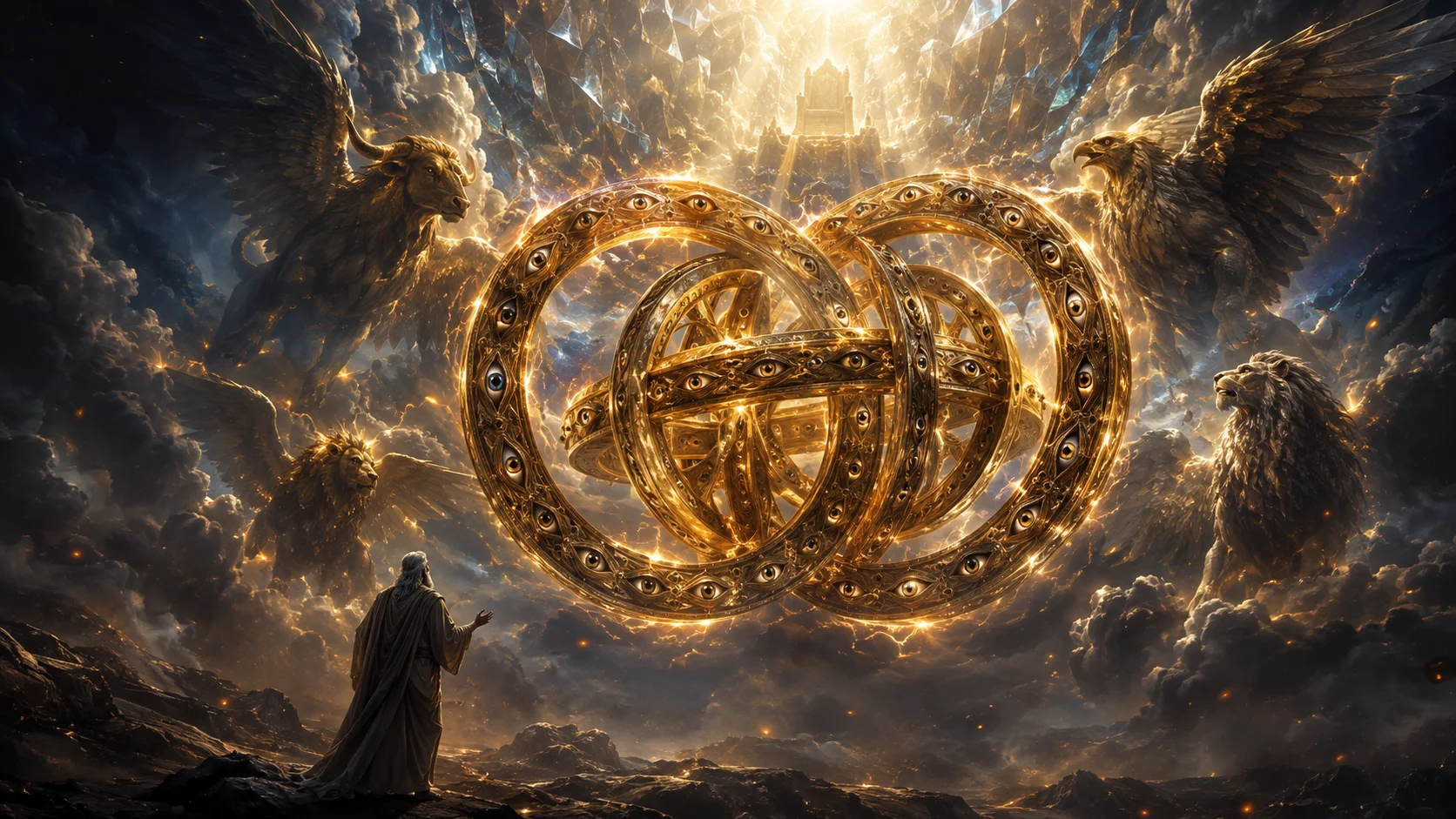
Four living creatures emerge from a storm of fire and cloud. Beside them are enormous intersecting wheels whose rims are covered in eyes. The wheels move in every direction without turning, rise from the ground and follow the creatures wherever they go.
Modern readers look at this and think:
Machine.
Some go one step further.
Spaceship.
But the wheels are only the bottom of what Ezekiel sees.
What Ezekiel Actually Describes
The vision begins with a violent wind coming from the north.
Inside a vast cloud, Ezekiel sees flashing fire and a glowing substance that resembles polished metal. Four living creatures emerge from it.
They have roughly human bodies, but each has four wings and four faces: a human, a lion, an ox and an eagle. Their legs are straight, their feet resemble calves’ hooves and they shine like burnished bronze.
Fire moves among them.
They flash back and forth like lightning.
Beside each creature is a wheel.
Ezekiel describes each wheel as appearing to contain or intersect another wheel. Their construction allows them to move in any of four directions without turning. When the creatures move, the wheels move. When the creatures rise from the ground, the wheels rise with them.
The rims of the wheels are tall, terrifying and covered with eyes.
Above the creatures is something resembling a glittering crystalline surface.
Above that is a throne the colour of sapphire.
Upon the throne sits a human-shaped figure surrounded by fire, radiance and something resembling a rainbow.
Only then does Ezekiel explain what he believes he is seeing.
It is an appearance of the glory of God.
The wheels are not the entire object. They belong to a much larger structure connecting the earth, living heavenly beings, a crystalline expanse and a divine throne.
Ezekiel is not describing a machine from the outside.
He is looking upward through the moving architecture of heaven.
The Creatures Are Cherubim
Later in the book, Ezekiel identifies the four creatures as cherubim.
These are not the harmless winged babies that appeared much later in European religious art and eventually spread to greeting cards, porcelain ornaments and other places where terrifying biblical beings go to lose their dignity.
In the Hebrew Bible, cherubim are powerful heavenly guardians associated with sacred space and the presence of God.
Images of cherubim stood above the Ark of the Covenant, their wings stretched over it. The Ark was connected with the earthly throne or footstool of God within the sanctuary.
Ezekiel’s cherubim appear to perform a similar function on a cosmic scale.
They do not sit inside the strange object.
They carry the throne above it.
Their four faces may represent different forms of earthly life, although interpretations vary. The human can suggest intelligence, the lion wild animals, the ox domesticated animals and the eagle the creatures of the sky.
Together, they present an image of creation assembled beneath the divine throne.
They also face every direction.
The structure does not need to turn around because one face is already looking whichever way it moves.
Why the Wheels Move Without Turning
The wheels follow the same principle.
Ezekiel’s wording has produced many attempts at reconstruction. The usual image is a pair of wheels crossing at right angles, allowing movement in four directions.
That sounds mechanical to modern ears, but the point may not be mechanical efficiency.
The point is unrestricted movement.
An ordinary chariot must turn. Its animals must change direction. Its driver must steer it around obstacles.
This throne goes wherever the spirit directs.
It does not need a road.
It does not need to reverse.
It does not appear bound by gravity.
Ezekiel repeatedly says that the spirit of the living creatures is within the wheels. The wheels are not lifeless equipment attached beneath them. Creatures and wheels behave as parts of one animated heavenly system.
The throne does not merely travel.
It lives.
Why Are the Wheels Covered in Eyes?
The eyes remain the most unsettling part of the vision.
Ezekiel does not explain them directly, leaving generations of readers with the delightful task of imagining enormous airborne wheels staring back at them.
The most common symbolic interpretation connects the eyes with awareness, vigilance and divine knowledge.
That fits the structure of the vision.
The creatures face every direction.
The wheels move in every direction.
The eyes see in every direction.
Nothing lies outside the vision of the throne.
The eyes may therefore express the same idea as the impossible movement. God’s presence is not limited by distance, orientation or the blind spots of physical creatures.
It can move anywhere.
It can see everything.
This becomes especially important when we consider where Ezekiel is standing.
Why the Vision Happens in Babylon
Ezekiel is not inside the Temple of Jerusalem when the heavens open.
He is among Jewish exiles in Babylonia, far from the land, city and sanctuary at the centre of their religious life.
Jerusalem had not yet been completely destroyed when Ezekiel’s visions began, but many Judeans had already been deported. They were living under the power of a foreign empire, beside canals and settlements hundreds of kilometres from home.
Then the divine throne appears in Babylon.
This is not just spectacular imagery. It makes a theological claim.
The God of Israel is not trapped in Jerusalem.
He is not confined inside the Temple.
He does not lose jurisdiction at the border.
His throne has wheels.
Later in the book, Ezekiel sees the divine glory rise from the Temple and depart from Jerusalem. The cherubim and wheels move with it.
The same structure that can appear among the exiles can also leave a corrupted sanctuary behind.
The wheels therefore represent something more unsettling than transportation.
They mean that the divine presence is free to arrive.
They also mean it is free to leave.
The Chariot of Jewish Mysticism
Later Jewish tradition came to call Ezekiel’s vision the merkavah, the Hebrew word for chariot.
The term came to describe the entire throne structure: the cherubim, wheels, crystalline expanse and throne moving together.
The vision eventually became central to an early form of Jewish mysticism known as merkavah mysticism.
Teachers treated the subject as dangerous knowledge that should not be discussed casually. Rabbinic writings placed restrictions on who could be instructed in the mysteries of the chariot.
The concern was not merely that students might misunderstand a difficult passage.
The vision was treated as a doorway into the structure of heaven.
Later writings known as the Hekhalot texts described mystics ascending through a series of heavenly palaces toward the divine throne.
The journey was filled with guarded gates, powerful angels, secret names and severe dangers for anyone who approached without the correct knowledge or preparation.
Ezekiel had seen the throne from below.
Later mystics attempted to follow it upward.
The wheels were no longer only something to interpret.
They marked the beginning of a route.
How the Wheels Became a Spaceship
The idea that Ezekiel witnessed extraterrestrial technology became popular during the twentieth century, particularly through ancient-astronaut writers such as Erich von Däniken.
The interpretation appears tempting.
Something descends from the sky amid fire and noise. It contains moving structures. Its occupants have unusual bodies. The prophet lacks modern technological vocabulary and therefore describes what he sees using familiar religious language.
The theory gained further attention through Josef F. Blumrich, an engineer who had worked for NASA.
Blumrich reportedly began examining the claim intending to disprove it. Instead, he became convinced that Ezekiel had witnessed a spacecraft.
In his 1974 book The Spaceships of Ezekiel, he reconstructed a conical landing vehicle supported by helicopter-like units. He interpreted Ezekiel’s wheels as multidirectional landing equipment.
The involvement of a NASA engineer made the theory considerably more impressive than the usual arrangement involving an enthusiastic television presenter standing beside a badly lit pyramid.
But engineering expertise does not automatically provide expertise in ancient Hebrew, prophetic literature or Near Eastern religious symbolism.
The spacecraft theory also requires almost every element in the vision to become something other than what Ezekiel says it is.
Eyes become windows or sensors.
Wings become rotors.
Cherubim become mechanical units or alien crew.
The crystalline expanse becomes part of a craft.
The throne becomes a command seat.
Divine fire becomes propulsion.
The interpretation is possible only after the religious structure of the vision has been dismantled and rebuilt as technology.
Once every symbol has been translated into machinery, machinery is naturally what remains.
Was Ezekiel Describing a Real Experience?
Rejecting the spacecraft theory does not settle what happened beside the canal.
Ezekiel may have experienced a prophetic trance, a dreamlike vision, an altered state of consciousness or a psychological event shaped by exile, religious tradition and personal crisis.
The imagery may draw from temple symbolism, royal chariots, Babylonian art, guardian creatures and storm imagery associated with divine appearances.
It may also preserve an experience that Ezekiel believed was genuinely external to him.
The text does not allow us to interview the prophet, measure his brain activity or inspect the sky above sixth-century Babylonia, which is rather inconsiderate of it.
What we can determine is what the vision means within the book.
It presents a divine throne that can cross borders.
It gives that throne living bearers facing every direction.
It places beside them wheels that move without turning.
It covers those wheels with eyes so that nothing escapes their sight.
Then it raises the entire structure from the earth and carries it wherever the spirit chooses.
The UFO interpretation tries to make Ezekiel’s vision easier to understand by giving him a machine.
The original text offers no such comfort.
Ezekiel did not merely see something flying through the sky.
He saw the heavens open, a throne become alive and countless eyes begin moving toward him.
Whether that happened in the sky, in the mind of a prophet or somewhere between the two remains the part the wheels refuse to explain.